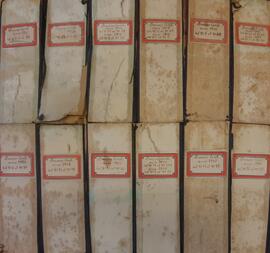
1911 (27/03/1916 - 31/10/1916
General registers of criminal case files.
Article 251 of the 1866 Consular Regulations provides that “every criminal proceeding conducted by consuls” be recorded in a dedicated register. The data to be recorded include:
- name, surname and residence of the accused;
- name, surname and residence of the injured party;
- nature of the offence under investigation; measures issued during the investigation or definitively.
“It shall also be indicated in the register whether the injured party has entered an appearance as a civil party and whether any deposit has been made.”
Criminal case files could be retrieved through this repertory, compiled in the forms prescribed by the Consular Regulations. Today these registers (almost complete for the years 1922–1937) constitute, for this part of the archive, a true archival inventory enriched with highly specific and detailed information.
Il primo registro ha inizio con il 1922. Le registrazioni dei fascicoli prodotti negli anni 1916-1921 sembrano riferirsi alle posizioni ancora aperte nel 1922
1-236 (1916-1921);
1-322 (1922);
1-405 (1923);
1-496 (1924);
1-486 (1925)
1-427 (1926);
1-422 (1927);
1-507 (1928);
1-438 (1929);
1-510 (1930);
1-339 (1931).
340-456 (1931);
1-500 (1932);
1- 434 (1933);
1-147 (1934)
148-334 (1934);
1-457 (1935);
1-387 (1936)
1-472 (1937)
1921-1922: n. 1-135; 1923: n. 1-249
These documents give a detailed picture of the consular activities carried out by the consular representation during that long period. However, the archives of the consular courts constitute the core of the archive.
In addition the following documents are also noteworthy:
- correspondence organised into separate classification categories
- documentation relating to 'Schools'
- the almost complete series of “Successions”
- an interesting “Conscription” archive
- a sample of “Expulsions”
The relations of the Italian Consulate in Cairo can be traced through the correspondence exchanged by the consular offices in Cairo with institutions in Italy, local authorities, other consular and diplomatic offices, and nationals settled in Egypt.
This section includes numerous volumes, surviving from a broader system for recording incoming and outgoing correspondence: letter-copy books of outgoing correspondence and protocol registers. Significant gaps are evident.
Where they exist, the protocols make it possible to reconstruct—albeit in a concise form—the relations maintained by the offices. The brief description of the records and the system of cross-references in fact allow the documentation to be reconstructed and, at times, located within the case files (folders).